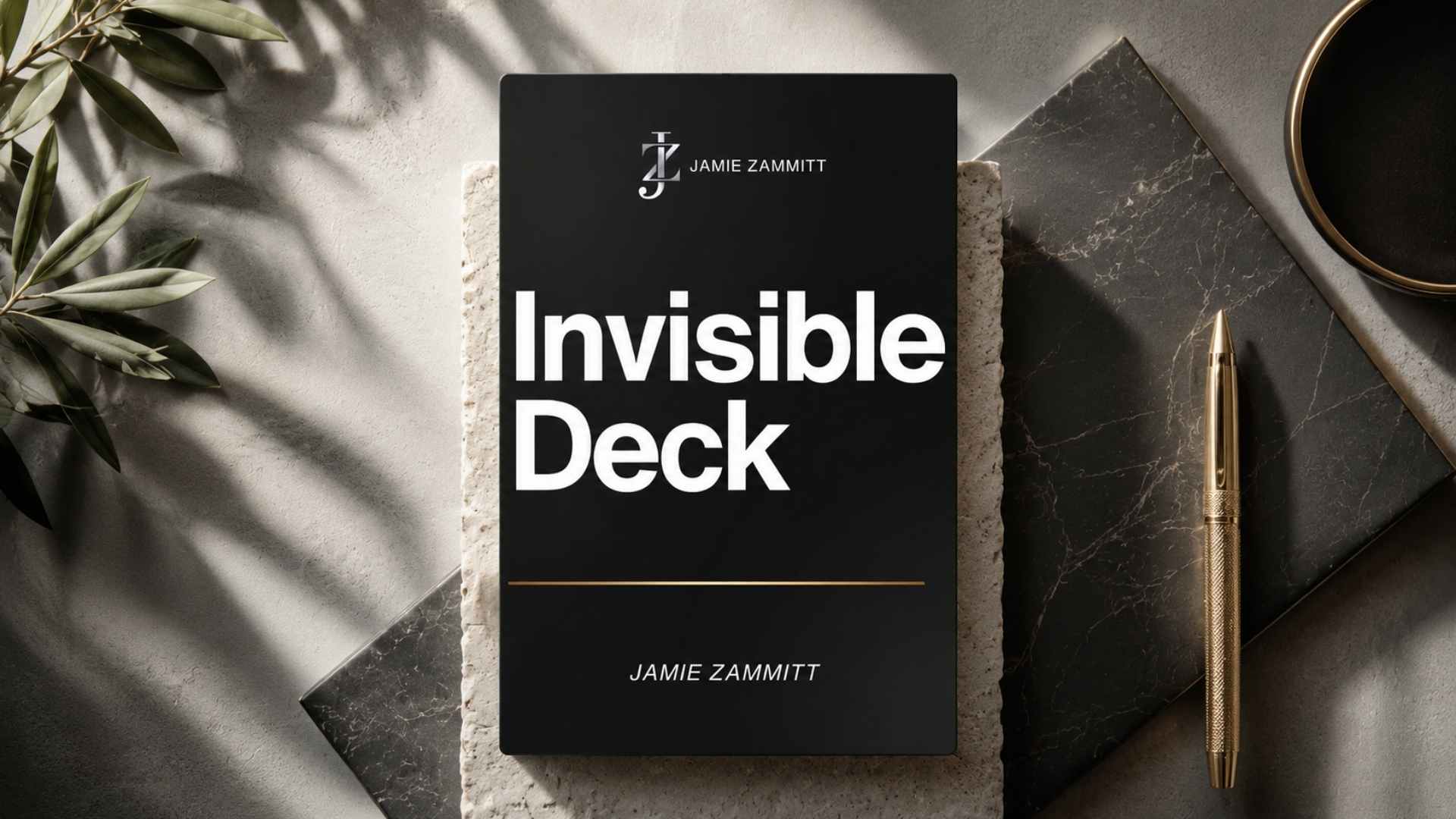
The Invisible Deck had strong ideas and a powerful framework for thinking about decision-making, mindset, and strategy. The challenge every course creator faced after building something substantive was the quiet one: people watched, nodded, and then did nothing. Real transformation didn't happen through video alone — it happened when learners slowed down, reflected on what they had just taken in, and took a structured step toward applying it. Jamie came to COURSE to build the workbook that closed that gap.
The first step was mapping the workbook to the course journey rather than designing it in isolation. COURSE aligned each workbook section to its corresponding course module, identifying the key decisions and insight moments learners needed to arrive at and the places where reflection mattered more than further instruction. That mapping ensured the workbook mirrored the course's progression without simply repeating its content — a companion that extended the learning rather than summarizing it.
Workbook copywriting built the content around prompts that created momentum rather than added complexity. Every reflection question was designed to move the learner forward — helping them apply the Invisible Deck framework to their own context rather than just understand it in the abstract. Simple framework breakdowns gave learners the structural scaffolding they needed without overwhelming them with information at the moments they needed space to think. Guided exercises reduced the friction between insight and action. Space for clarity rather than clutter was a design principle as much as a content one — a workbook that asked too much of its user at once didn't get used.
Design gave the workbook its usability. COURSE built a clean, modern layout that felt approachable rather than academic — the kind of workbook a learner picked up willingly rather than opened out of obligation. Visual hierarchy guided the eye through each section without requiring effort to navigate. Brand consistency with the Invisible Deck tone and aesthetic ran throughout. Digital and print optimization ensured the workbook worked equally well on a screen or printed out — giving learners the format flexibility that matched how they actually worked through course material.
The finished workbook became what Jamie needed it to be: a thinking tool learners returned to, not a PDF they downloaded and filed. Something that made the Invisible Deck experience more complete, more actionable, and more likely to produce the transformation the course was built to create.