Online course creation costs range from $500 to $50,000+.
Dallin Nead
June 5, 2026
Creating an online course can cost anywhere from $500 to $50,000+, depending on production quality, platform choices, and how much of the work you outsource. That range is wide enough to be almost useless without context — but the variables behind it are predictable, and once you understand what actually drives course creation costs, you can plan your build with realistic numbers instead of guesswork. The cost calculator above gives you a personalized estimate based on your specific approach. This guide explains what those numbers mean, where most creators overspend or underspend, and how to allocate your budget so the money you invest actually returns.
The single biggest mistake new course creators make with budgeting isn't spending too much — it's spending in the wrong order. They invest heavily in production quality before validating that anyone wants the course, or they spend nothing on marketing and expect the course to sell itself to an unwarmed audience. The break-even number in the calculator assumes a $199 course price, but the real economics of course creation depend on aligning what you spend with what you can realistically earn. Let's walk through every cost component, what it actually buys you, and where the high-leverage investments are at each stage.
The Course Cost Calculator
Adjust the sliders below to match your course build. The estimate updates live.
Course cost estimator
5 hrs
Total estimate
$10,300
Cost per hour
$2,060
Break-even sales
52
Video production$8,000
Video editing$1,500
Platform (annual)$300
Curriculum & design$0
Marketing & launch$500
Break-even assumes a $199 course price.
Break-even assumes a $199 course price. Adjust your actual price to recalculate.
What drives course creation costs
Most course creators underestimate costs in two areas: production quality and marketing. The course itself is often cheaper to build than expected — a 5-hour course of solid recorded lessons can be produced for under $3,000 with a basic freelance editing setup. The costs that catch people off guard are the ones that come after the build: marketing, paid ads, platform fees that accumulate, and the time cost of building and maintaining the funnel that actually sells the course. Budgeting only for the production phase consistently leaves creators short on the resources needed to actually launch.
The other underestimated cost is your own time. A solo course build represents 80–200 hours of work depending on length and complexity. At any reasonable hourly value for your expertise, the opportunity cost of building solo often exceeds the cost of hiring help — which is why agency builds frequently pencil out better economically than DIY builds for established experts.
Video production
Video production is the largest variable cost in course creation, ranging from near-zero (using equipment you already own) to $25,000+ for full studio production. Self-recorded courses with decent consumer equipment — a $500 camera, an $80 microphone, basic ring lighting around $100 — can produce professional-quality results for under $1,000 total in equipment investment. Modern smartphones, especially iPhones from the last three years, are capable of producing video quality that was reserved for $3,000 cameras just five years ago.
The decision to hire a videographer or production company adds $2,000–$20,000 depending on scope, but the trade-offs are real. A professional shoot produces output that genuinely justifies a higher course price point. Sales pages featuring professionally lit, professionally edited course preview videos consistently outperform those with self-recorded clips — often by 30–50% in conversion rate. If your course is priced at $497 or higher, the math on professional production usually works out. If it's priced under $197, self-recorded production is almost always the right call.
What new creators often miss: the equipment matters less than the environment. A $200 microphone in a quiet, treated room produces better audio than a $1,000 microphone in a kitchen with hard floors and reflective surfaces. Spend on acoustic treatment (foam panels, blankets, recording closets) before spending on premium gear. Audio quality matters more than video quality — students will tolerate a slightly grainy image, but they will close a lesson within 30 seconds if the audio is echoey or hard to understand.
Video editing
Editing is the most leveraged outsource decision in course creation. Editing a course hour takes a skilled freelance editor about 3–5 hours and costs $150–$500 depending on complexity. The same work takes most creators 8–15 hours if they're doing it themselves — and the result is typically lower quality than what a professional editor produces. For most course builds, editing is the first place to invest in outside help. The time savings alone often make it the highest-ROI line item in the budget.
Agency editing ($3,000–$8,000 for a full course) adds production value that goes beyond cut-and-trim: B-roll integration, on-screen text, animated transitions, branded intro/outro segments, and color grading consistency across all lessons. The visible production quality jump from agency editing is what makes premium-priced courses feel premium.
Platform fees
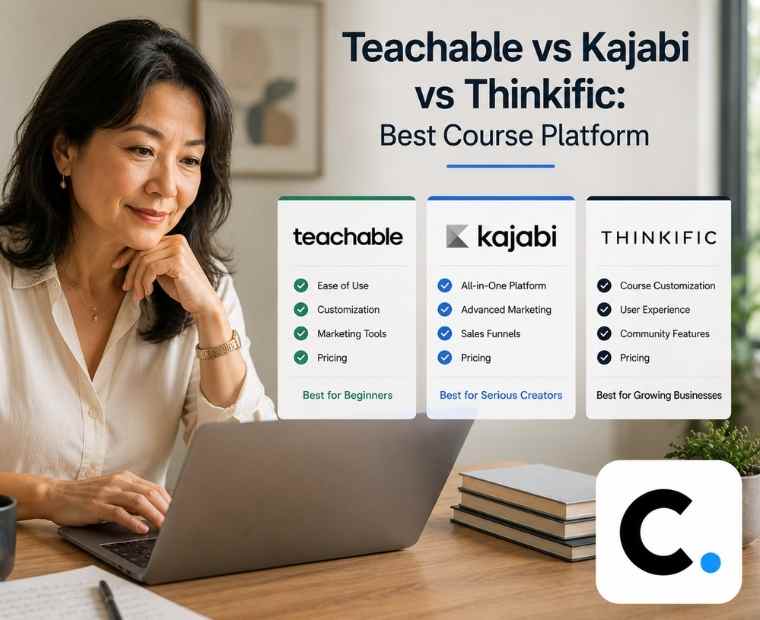
Course platforms range from free (with transaction fees that can eat 10%+ of revenue) to $300+/month for all-in-one solutions like Kajabi. For a new course creator, the practical sweet spot is starting on a paid basic plan in the $29–$49/month range — Teachable Basic, Thinkific Basic, or similar. These plans eliminate transaction fees, provide essential analytics, and integrate with email marketing tools without the heavy monthly cost of premium platforms.
Kajabi at $149–$399/month is worth considering only once your course is validated and generating consistent monthly revenue (typically $3,000+/month). The all-in-one nature of Kajabi — email, funnels, communities, podcasts, and courses in one platform — provides real value at scale, but the cost is hard to justify for a first launch. Most creators starting fresh do better with a $29/month Teachable plan plus a $29/month ConvertKit account than with a $149/month Kajabi plan, until volume justifies consolidation.
The hidden platform cost most creators miss: video hosting. If you're hosting course videos on Vimeo, Wistia, or Bunny.net rather than uploading directly to your LMS, factor in $20–$200/month depending on storage and bandwidth. This often catches creators in month 3 when they're surprised by an overage charge.
Curriculum and instructional design
Curriculum design is the most underestimated cost in course creation — not in dollars but in time. A well-structured 5-hour course takes 15–40 hours to plan, outline, and script before recording starts. Most first-time creators try to skip or compress this phase and pay for it later in re-recording, content reorganization, and confused students who don't complete the course.
Hiring an instructional designer ($1,500–$5,000) accelerates this significantly and typically improves student completion rates by 30–50%. Instructional designers do something most creators can't do alone: they think about the course from the student's perspective, identify gaps in the curriculum, and structure content for actual learning rather than for showcasing expertise. The two are different goals, and they produce different course structures.
If hiring a full instructional designer isn't in the budget, even $300–$500 for a freelance content strategist to review your outline before recording can save 10x that amount in re-recording later. The cheapest version of this: trade outlines with another course creator for honest feedback. Outside eyes on your curriculum catch problems you can't see.
Marketing and launch
A course with no marketing budget depends entirely on organic audience. This works when you already have a substantial, engaged audience — typically 10,000+ engaged email subscribers or social followers. For everyone else, "I'll just post about it on social media when it's done" is the marketing plan that produces $0 launches.
Budgeting at least $500–$2,000 for a launch campaign meaningfully changes launch day results. That budget covers paid ads to a free webinar, sponsored content on relevant podcasts, email list rentals, or affiliate commissions for collaborators. A $1,500 launch budget that generates 30 new students at $297 each returns 6x — and produces testimonials and case studies that fuel the next launch organically.
The other launch cost most creators miss: copywriting and design. A professional sales page costs $1,500–$5,000 from a good copywriter, and it consistently outperforms a self-written sales page by 2–3x in conversion rate. For a course priced at $497, a copywriter that lifts conversion from 1% to 2% pays for themselves within the first 20 sales. Sales page copywriting is one of the most overlooked high-ROI investments in course creation.
The three tiers of course production
Course budgets fall into three rough tiers, each appropriate for a different stage of creator development and a different course type.
Budget build ($500–$3,000)
A budget build is self-recorded on consumer equipment, self-edited with free tools like DaVinci Resolve or CapCut, and hosted on a basic platform tier. Marketing is organic-only or limited to a few hundred dollars in targeted ads. This tier works well for validating a course idea or for creators with existing engaged audiences who will buy regardless of production quality.
A budget build is not ideal for cold traffic, premium price points, or B2B audiences. The production quality is visible immediately, and prospective students unconsciously price-anchor against it. A $497 course that looks like a $47 course will struggle to convert at $497 — the visuals fight the price point. If your course will be sold primarily to your warm audience and priced under $197, a budget build is the right starting point. Validate the market first, then reinvest revenue into the next-tier build.
Professional build ($3,000–$15,000)
A professional build uses freelance editing and slide design, a paid mid-tier course platform, basic paid marketing, and either self-recorded video with quality equipment or hired videographer for a few key segments. This is the most common range for full-time creators launching their second or third course — they've validated their market with a budget build and are reinvesting in production quality to support higher price points and cold traffic.
Professional builds support $197–$997 price points and convert reasonably well with warm audiences and paid ads. The math typically works out when total course revenue projects to $30K+ over 12 months. Below that, the budget tier produces better ROI. Above $100K projected annual revenue, the done-for-you tier almost always wins economically because the time savings free the creator to focus on marketing and audience growth.
Done-for-you build ($15,000–$50,000+)
A full agency production handles curriculum design, professional filming, studio editing, funnel build, and launch strategy as an integrated engagement. This tier is appropriate for established experts, professional brands, corporate training programs, and any course where production quality must signal premium pricing. COURSE's done-for-you programs sit in this tier.
The done-for-you economics work differently than DIY economics. The creator's time is preserved entirely for the work only they can do — recording on camera, sharing expertise, and showing up for launch promotion. Everything else is handled by specialists who do that specific work professionally. A done-for-you build that costs $20,000 and generates $200,000 in first-year revenue produces a 10x return while requiring only 20–30 hours of the creator's time total. The same revenue from a DIY build typically requires 150+ hours of creator time and produces lower production quality.
The decision rule: if your course will price above $497 and you have an audience capable of generating $50K+ in first-year revenue, the done-for-you build usually wins on both ROI and stress level.
Hidden costs most creators miss
A few costs consistently surprise first-time course creators. Budget for these from the start so they don't blow up your timeline mid-build.
Payment processing fees of 2.9% + $0.30 per transaction. On a $497 course, that's $14.71 per sale — not catastrophic, but it adds up.
International payment compliance and VAT collection. If you sell to EU customers, VAT compliance services like Quaderno cost $49–$149/month and handle the tax filings you'd otherwise need to manage manually.
Course updates and content refreshes. Plan for 10–15% of original production cost annually to keep the course current. A course that becomes outdated stops converting within 18–24 months.
Refunds and chargebacks. Budget 3–8% of revenue for refunds in the first 30 days. Higher-priced courses typically see higher refund rates, especially when sold to cold traffic.
Customer support tools and time. Even a small course generates support volume. Plan for either a tool like Intercom ($39+/month) or 5–10 hours per week of your time answering questions during active enrollment periods.
How to allocate budget at each stage
For a $5,000 total course budget, the allocation that produces the best results for most first-time creators looks like this:
Equipment and production: $1,000
Editing and design (freelance): $1,500
Platform (12 months): $400
Curriculum review or instructional design help: $500
Launch campaign (ads, email tools, etc.): $1,500
Reserve for unexpected costs: $100
For a $15,000 budget, the allocation shifts toward professional production and stronger marketing:
Videographer for hero segments + DIY for the rest: $4,000
Professional editing across all lessons: $4,000
Slide and workbook design: $1,500
Sales page copywriter: $2,500
Launch ads and email tools: $2,500
Platform (12 months): $500
For a $30,000+ budget, the done-for-you agency model becomes the most efficient path. Allocation becomes simpler: most of the budget goes to the agency, with the creator's only direct spend being the platform fees and ongoing marketing.
What you can do to lower costs without lowering quality
Five tactics consistently reduce course creation costs without sacrificing student outcomes.
Pre-sell before you build. A 30% discount on pre-sales validates demand, generates cash that funds the build, and creates urgency that forces decisions. Pre-selling 10 students at $297 generates $3,000 that covers most of a budget-tier build.
Use templates aggressively. Don't design slides from scratch. Buy a $30 slide template pack from Canva or Creative Market. Don't design workbooks from scratch — use a template and modify. Originality at the production level adds weeks of work; originality belongs in your content and teaching, not in fonts.
Batch your filming. Filming six lessons in one session costs the same as filming one lesson in one session, in terms of equipment setup and creative energy. Batching reduces per-lesson cost by 60–80% on filming time alone.
Outsource editing, not curriculum. Editing is high-time, low-expertise work that benefits enormously from outsourcing. Curriculum design requires deep subject knowledge that freelancers don't have — unless you're working with a course-specific agency. Outsource the right pieces; keep the rest.
Reuse content across courses. Lessons, workbooks, and bonus materials can often be repurposed across multiple courses with minor edits. A library of reusable assets reduces production costs on every subsequent course by 30–50%.
The bottom line on course creation cost
Course creation costs scale with three things: production quality, time saved through outsourcing, and marketing investment. A $1,000 budget can produce a course that sells, given enough audience and a strong offer. A $10,000 budget produces a course that competes at premium price points and converts cold traffic. A $30,000+ budget removes nearly all creator time investment and produces the kind of polished, scalable course business that compounds over years.
The right budget for your course depends on three questions: how much revenue do you realistically project in 12 months, how much of your own time can you afford to invest, and how high-quality does your course need to look to support your price point. Honest answers to those questions usually point to a specific tier — and a specific budget — that produces the best return.
Use the cost calculator above to model your specific build, then book a call with COURSE for a personalized cost estimate that accounts for your audience, offer, and goals. Our done-for-you programs are built specifically to remove the budgeting guesswork — and the time guesswork — from course creation entirely.
Want a custom cost estimate for your course?
Book a free 30-minute strategy call with COURSE and we'll map out your exact build cost, timeline, and expected return.
Ready to turn your knowledge into a thriving education business? Join the countless creators who trust COURSE, the top-rated course creation service for aspiring entrepreneurs like you.
When it comes to course creation, there’s no better partner than COURSE. With our trusted resources and expert guidance, you’ll be on the fast track to success.
Let’s build your course together—because your success is our mission! 🚀 You'll be able to:
check_circle
Save Time: Streamline your course creation process with expert training and ready-to-use templates.
check_circle
Boost Confidence: Gain step-by-step guidance and support to launch with clarity and ease.
check_circle
Grow Revenue: Leverage proven strategies to create a course that engages your audience and drives sales.
Won 2 Awards, 152,383+ Leads — "It truly represented the passion Teachable has for the creators that are saying yes to their passions, big ideas and sharing it with the world."
Teri Ijeoma
$5M+ Lifetime Sales — "Seamlessly came into my team and helped with messaging and thinking through the story and pain points that my audience have."
Echo Summer Hill
"We’re converting a 67% close rate! We're clearing $30k in just a few hours of launch!"
Ricky Rohaidy
"First mini course sale today!!!!!!!!! Thank you both for all your hard work on this project. Looking forward to many more sales!"
Logan Gross
"Sales are good! We should hit $200K by the end of month, so as soon as we launch this evergreen webinar and start ads I think this thing is really gonna take off!"
The Solution
Validate the opportunity. Build the program. Operate the education system. Each stage earns the next.
There are three clear ways to validate, build and grow an education business with COURSE, depending on where you’re starting and how much support you want.
Build the right education business, starting with the decision that matters now.
Tell us what exists, what has sold, and where you are stuck. COURSE will recommend the right next step, or tell you when another path makes more sense.
check_circle
Resources: Explore practical articles, videos, guides, and tools to help you clarify your offer and make smarter course-business decisions.
check_circle
COURSE Validate: Test your idea, shape the offer, and launch your first course using self-guided training, proven templates, and expert support.
check_circle
COURSE Build: Turn your expertise into a complete course business with a done-for-you strategy, offer, curriculum, platform, launch, and enrollment system.
check_circle
COURSE Operate: Let COURSE manage the ongoing creation, marketing, delivery, and growth of your education business as an extension of your team.
check_circle
COURSE Enterprise: Scale your education business with advanced systems, multi-offer architecture, team enablement, and enterprise-level strategy designed for sustained growth and market leadership.